EMS in the
United States
Fragmented Past, Future of Opportunity
About This Book
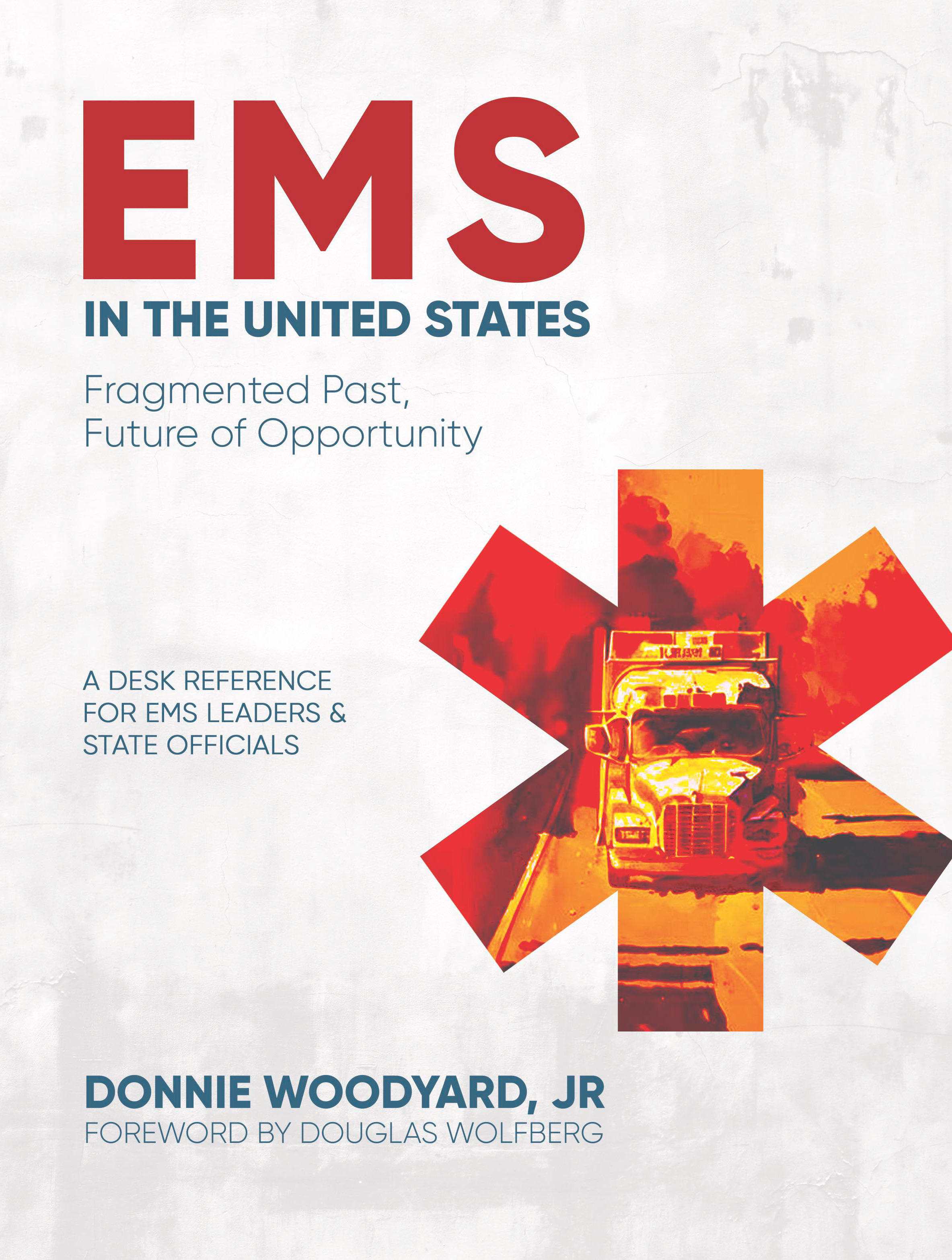
The first comprehensive desk reference for aspiring EMS leaders, managers, and government officials. Written from the perspective and experience of a state and national EMS leader, the book provides an exploration into the evolution, current state, and future of Emergency Medical Services in the United States.
From the humble origins of EMS to the impact of influential visionaries, Hollywood, and determined community volunteers, this book provides a deep dive into the rich, often overlooked history. The author also leverages his experience to explain different service delivery models, financial challenges, and the significance of insurance and billing.
As a resource for emerging EMS leaders, the book guides the reader through state regulation and administration, providing an introduction to interstate compacts, investigations, enforcement, and public protection. In its final sections, the book outlines leadership lessons, stakeholder engagement, and change management in the EMS environment.
Who Should Read This Book
Primary Source Library
This book is accompanied by a companion library of 87 primary source documents spanning 1863 to 2025 — congressional reports, federal guidelines, founding charters, and policy papers that shaped modern EMS. Explore them in context through the Interactive Timeline.
Explore the Timeline →Foreword

EMS Attorney & Founder, Page, Wolfberg & Wirth
President John Quincy Adams said that a leader is anyone who inspires others to do more, dream more and become more. EMS is highly regimented and often focused on levels of licensure, supervisory vs. field provider status and other indicia of rank and title. But leadership need not be constrained by such classifications. Any EMS professional can be an EMS leader under the formula handed down to us by President Adams.
Anyone who is a leader or aspires to leadership in this profession must read this important work. EMS owes Donnie Woodyard a debt of gratitude for documenting our history and illuminating the future course for the profession. EMS in the United States: Fragmented Past, Future of Opportunity is a magnificent and monumental work.
Those who have been involved in EMS for a long time often refer to themselves (and are often referred to by others) as "EMS dinosaurs." Though EMS dinosaur status does not have a precise unit of measurement, as someone who has been involved in EMS for 45 years as of this writing, I suppose I qualify. I've also had the privilege of close associations with the generation of EMS dinosaurs that came before me, some of whom were acknowledged "founding fathers" of the EMS profession. So, I have had a front row seat, either as a direct participant, or as a recipient of firsthand accounts, of EMS throughout almost its entire modern history. I've come to terms with my EMS dinosaur status, largely because it allows for an unparalleled vantage point from which to assess the state of affairs of a profession to which I have dedicated my entire working life.
I answered my first ambulance call in 1978. For the first 30 years, I can say with the benefit of hindsight that the pace of progress in EMS was glacial at best. Nothing, it seemed, was revolutionary – it was barely evolutionary – and painfully so. Many practices – both operationally and clinically – were done simply because "we've always done it this way" (which Admiral Grace Hopper correctly said was "the most dangerous phrase in the language"). While EMS still clings to some of these anachronisms (red lights and sirens, anyone?), we've entered, and are firmly entrenched in, the era of evidence-based practices. The implications have been profound.
In comparison to the snail's pace of progress in EMS I witnessed in my first 30 years, I believe that the past 15 years have been a time of breathless and exciting change. How energizing it has been to see the unflinching gaze of data and evidence topple so many sacred cows. Everything we do deserves fresh scrutiny. Why does everyone who calls 911 require a full EMS response? Why do we run "hot"? Why does every response require transport to an acute care hospital? Can some conditions be effectively managed outside the hospital? Can some patients be transported to destinations other than acute care hospitals to effectively manage their conditions? Can telehealth play a role in more appropriately providing out of hospital care?
EMS outwardly looks like public safety. Our vehicles have markings, lights and sirens – and our people wear uniforms – that connect us by appearance to our fire and police counterparts. But make no mistake: EMS is healthcare. Some EMS systems over the past 15 years have reengineered themselves as participants in the broader community healthcare system. And herein is the exciting future that lies ahead. For a profession that started modestly as a "ride to the hospital" with minimally trained first-aid attendants, EMS is becoming community-based healthcare. "EMS providers" are becoming practitioners. "Crew members" are becoming clinicians.
These are truly momentous times in EMS. To use a golf metaphor (strange, since I'm not a golfer), I often wish I wasn't already on the "back nine" of my career. I'd like to help shape the next 45 years of our profession. I've always thrived on change, and what's in store for EMS is exciting. Being an EMS leader in such times of change can be enthralling and satisfying.
Though I hope I have a bit more to contribute, the future belongs to the next generation of EMS leaders, and the ones after that. But past is prologue. To build a future we must understand the past. We must learn from our failures as well as from our successes. The future of EMS will be what you – our future leaders – make it. This book is your roadmap. Study our history and then go out and make EMS history anew.
Mechanicsburg, Pennsylvania
July 2023
Preface
Today's Emergency Medical Services (EMS) system operates as a critical cornerstone of the United States' healthcare infrastructure. It serves communities around the clock, demonstrating extraordinary dedication, resilience, and adaptability, particularly during the recent COVID-19 pandemic. Each day, the EMS system proves instrumental in saving countless lives and providing a healthcare safety net for millions of Americans, notably those without consistent access to primary care.
However, the current EMS system is traversing challenging terrain. Many see the system teetering on the brink of crisis, with states nationwide rigorously questioning its sustainability and seeking for new solutions to ensure its long-term viability. These challenges are not sudden anomalies but are rather the repercussions of a series of decisions and events deeply rooted in its multifaceted history.
This history includes significant contributions from visionaries like Dr. J.D. 'Deke' Farrington, a leading orthopedic surgeon, and Dr. Pete Safar, the father of critical care medicine and modern resuscitation science. It also highlights the ironic circumstance where ambulance services, once predominantly provided by funeral homes, underwent a significant transition. In the 1960s and 1970s, many funeral homes ceased these services, not predominately due to regulatory changes, but due to a failing financial model.
Pivotal moments included the attempts by the federal government to establish two parallel, yet unfortunately uncoordinated, nationalized EMS systems in the 1970s. These initiatives, backed by over $2 Billion (valued in 2023 dollars), led to federal agencies providing conflicting requirements to state officials. This lack of coordination, along with the military's considerable influence on EMS design and progression, has left enduring impressions on today's EMS landscape.
EMS pioneers strove to align the system's development with the conventional growth paths of other allied health professions. Yet, this aspiration was not consistently achieved nationwide. National standard curriculums and certification bodies established as early as the 1970s often found their influence overshadowed by local champions, who developed EMS agencies at the community level, fostering an aversion to national standards.
The abrupt changes and significant reduction in federal funding in 1981 forced communities to pursue alternative resources for their local ambulance services. This transition heightened skepticism towards any federal or national program. In EMS in the United States: Fragmented Past, Future of Opportunity, these historical trends and their implications on the current state of EMS are thoroughly examined.
Despite these challenges, EMS remains a critical element of the healthcare system today. The future holds opportunities to further unify the profession, leveraging tools such as the EMS Compact. With new technological advancements and the emergence of telehealth, there exists a new frontier for EMS to enhance health provision and perhaps create a sustainable financial model.
This book aims to serve as a comprehensive resource for aspiring EMS leaders and managers. It offers a detailed understanding of EMS's roots, the challenges it has faced, and the opportunities that lay ahead. The book explores historical developments, the roles of visionaries, the influence of Hollywood, and the significance of the emblematic Star of Life. It also scrutinizes systemic issues such as financial structures and disparities in access that underscore EMS operations.
Moreover, the book elucidates the certification, licensure, and credentialing processes, state sovereignty implications, and the promising prospects of telehealth and health equity in EMS. By tracing EMS's complex trajectory from its fragmented past to its opportunity-rich future, it invites readers to participate in informed discussions about the future of EMS.
EMS in the United States: Fragmented Past, Future of Opportunity provides an essential roadmap for aspiring EMS leaders and managers. It fosters a comprehension of the past to better manage the present and envision the future. This historical overview serves as a blueprint for understanding the present challenges and shaping the future of EMS. It advocates for a system that is efficient, equitable, and sustainable, thereby continuing its vital service to the American people.
Through this exploration, readers will gain insight into how the EMS system has evolved in the face of adversity and change. This knowledge equips future EMS leaders and managers with a historical perspective, vital for making informed decisions as they navigate the challenges and opportunities ahead.
In the age of technology and telehealth, EMS stands on the cusp of a new era. With the opportunity to further unify the profession through mechanisms such as the EMS Compact, there is potential for substantial growth and improvement. This book aims to highlight these opportunities and stimulate meaningful conversations about how to seize them effectively.
As we venture forward, it is important to remember that the history of our EMS holds the blueprint for its revival. Its future lies in the lessons learned from its past, the ingenuity of its present leaders, and the promise held by innovations yet to come. The EMS system's ongoing commitment to the well-being of the American people is a testament to its resilience and importance.
In the face of current challenges, we should be emboldened by the fact that the EMS system has always risen to meet every trial it has faced. Its fragmented past, marked by struggle and triumph, has forged a resilient system that continues to serve as a bedrock of our healthcare infrastructure.
The opportunity-rich future of EMS beckons, and this book invites all aspiring EMS leaders and managers to play a part in shaping it. It is a call to understand the past, manage the present, and envision a future where the EMS system continues to serve everyone with increased efficiency, equity, and sustainability.
Letter to the Reader
Throughout my more than thirty-year EMS career, I have come to appreciate the significance of having experienced mentors and dependable resources to navigate the intricacies of our complex EMS system. When I initially assumed leadership roles at both the state and national levels, I was struck by the scarcity of resources that could bridge the knowledge gap between local EMS leadership and the broader state or national leadership — understanding the history, grasping an overview of the organization, and possessing a guide to traverse the layers of influence. I was fortunate enough to have exceptional mentors, yet I witnessed many ambitious emerging leaders falter, in part, due to gaps in their knowledge and resources.
To help address this gap, I authored this book as a resource to provide a historical context for pivotal decisions that have shaped contemporary EMS systems. It is conceived as a desk reference, with each chapter functioning independently. You may notice some repeated information across different chapters, but this is intentional, serving to provide additional context in relation to the specific issue or historical event being discussed. Furthermore, I impart some insights drawn from my personal experience in leadership and management.
From the birth of EMS in the United States to current challenges such as health equity and COVID-19, my objective is to offer you an overview of key historical decisions and demonstrate how they persistently influence the design and operations of EMS in our country.
It is my hope that this book will not only act as a resource for budding EMS leaders, but also enable you to comprehend the historical underpinnings as the EMS system continues to modernize and evolve. By illuminating key facets of our history that are often neglected, we can delve deeper into understanding how EMS has developed, recognizing that our current state is inherently linked to past decisions.
I am eager for you to embark on this journey with me, exploring the rich history, complex present, and opportunity-laden future of EMS in the United States. The work you undertake is critical for the health and safety of our communities. I am optimistic that this guide will prove to be an asset to you as you work tirelessly to enhance emergency medical care in the United States.
Table of Contents
Section 1 — Foundations
- The Origins of EMS in the United States
- EMS Visionaries
- Hollywood's Role in Designing the U.S. EMS System
- A Guiding Star (of Life)
- Fractures & Fragmentation
- Volunteerism: The Ultimate EMS Subsidy
- EMS Data: The Most Powerful Healthcare Dataset
- National EMS: Offices, Organizations & Influencers
- EMS Week
Section 2 — EMS Systems & Operations
- EMS Service Delivery Models
- Disparities in Access to EMS
- Physician Medical Direction
- EMS System Finance
- Economics of Providing EMS
- Fundamentals of Insurance & Billing
- Essential Service Designation
Section 3 — EMS Personnel
- Certification, Licensure, & Credentialing
- National EMS Certification
- Paramedic Accreditation
- Recruitment & Retention of EMS Personnel
- EMS Provider Mental Health: Protecting Our Own
- A Professional Code of Conduct
Section 4 — State Regulation & Administration of EMS
- An Introduction to Interstate Compacts
- The EMS Compact
- State Sovereignty
- State EMS Offices
- Investigations & Enforcement
- Public Protection & Background Checks
Section 5 — Leadership & Management
- Visionary Leadership
- Stakeholder Engagement
- Leading Change Management
- Leadership Lessons
Section 6 — Emerging Issues
- Health Equity, Social Determinants of Health & EMS
- Aging Populations & EMS Systems
- Resilience, Reliability, and Sustainability
- Telehealth: The New Frontier
- We Are EMS
Appendix
- Peter's Laws
- Select 1976 EMS System Abstracts
- Norman McSwain, MD: Paramedic Training in Junior Colleges
- Nancy Caroline, MD: USDOT Curriculum for Advanced EMTs
- Colorado: Rocky Mountain EMT Satellite Refresher Course
- Oklahoma: Telephone Conference EMT Training
- Rocco Morando: The National Registry of EMTs
- David Boyd, MD: EMS Progress Report for the United States
- EMS Compact Model Legislation (2014)
- 1978 DOT Model EMS Legislation
- 1977 Congressional Inquiry
- Index
Acknowledgements
I would like to convey my deepest gratitude for the steadfast support and invaluable guidance I have received from countless mentors, friends, supervisors, and EMS leaders throughout my life. The myriad opportunities for learning and leadership, generously provided by various managers, have played a pivotal role in my development. For this, I remain profoundly thankful.
Looking back, I recognize that I often didn't fully appreciate the significance of the opportunities given to me. The privilege of engaging in meaningful dialogues, receiving mentorship, attending conference sessions, or simply sharing a cup of coffee with many visionaries who were instrumental in shaping my career and the modern EMS system, has been an inspiring journey. These luminaries, mentors, friends, and guides include numerous individuals, but I want to specifically acknowledge and appreciate Jeanne-Marie Bakehouse, Jeff Beckman, Gary Brown, Drew Dawson, Wayne Denny, Tim Dienst, Dia Gainor, Jon Krohmer, Debra McDonald, Scott Hayes, Susan McHenry, Norman McSwain, Rocco Morando, Jim Page, Rick Patrick, Peter Safar, Joe Schmider, Keith Wages, and Gam Wijetunge. I will forever be thankful for their willingness to generously share their time, historical insights, advice, and profound wisdom.
I am particularly grateful to the volunteers at Giles Rescue Squad who devoted their time to teach my first EMT class and initiate my journey into EMS. I'm also thankful to Cedarville University for entrusting me as the EMS Chief, which marked my first EMS leadership position. I extend my gratitude to numerous additional EMS agencies that provided me experience, opportunities, and guidance along the way: Cedarville University EMS, Cedarville Township Fire Department, Hamilton County EMS System, Riverview Hospital, Ivy Tech Community College, Westfield Fire Department, Med1, Falck, and the statewide system stakeholders in Louisiana and Colorado for their ongoing support and collaboration.
My appreciation also extends to the National Registry of EMTs for the opportunity to serve as the Chief Operating Officer and gain insights into national EMS leadership, the nuances of examinations and certification, and the chance to develop a national perspective on EMS. To the EMS Compact Commissioners, I extend my respect and gratitude for their pioneering efforts in setting a modern example of unity, professionalism, and standards in our field and the opportunity to learn and collaborate to make a difference.
I also wish to convey my heartfelt thanks to stakeholders and colleagues who have demonstrated remarkable understanding and grace during my moments of error. Your steadfast support and the learning opportunities offered have played a vital role in both my personal and professional development. I am extremely thankful to the many leaders who placed their trust in me, offering a novice like me an opportunity to contribute.
This book would not have been possible without the relentless efforts of those working tirelessly behind the scenes, providing invaluable fact-checking, guidance, and unwavering encouragement. To everyone who played a key role in this transformative journey, I extend my deepest gratitude. Your steadfast support has fostered my evolution in unimaginable ways.
While recognizing everyone's contribution is an impossible task, I want to express my heartfelt thanks to the following individuals who shared their invaluable feedback on this manuscript: Shawn Baird, Jeff Beckman, MD, David Bump, Sean Caffrey, Dia Gainor, John Moon, and Don Stanton. I would like to express special appreciation to Marc Pagan, Bill Siefarth, Joseph Schmider, and Douglas Wolfberg for their significant time devoted to feedback, edits, and critiques on the full manuscript.
I owe a profound debt of gratitude to my family as well. The sacrifices my parents made to ensure my access to education and the opportunity to chase my dreams have been nothing short of monumental.
Lastly, I must acknowledge my first employer, Burgess. His decision to hire a teenager evolved into an invaluable life lesson on problem-solving and overcoming preconceived limitations. His investment in me helped me understand the critical importance of investing in others. He taught me that by creating an environment conducive to success, minimizing the repercussions from failures, and prioritizing learning, one can indeed turn the impossible into the possible. This empowering approach enables individuals to reach previously unattainable heights. I am forever grateful for these lessons, which have profoundly influenced my outlook and actions.
Thank you, everyone, for being an integral part of this extraordinary journey and for contributing to my personal and professional growth.